Master's thesis · Lund University · 2026
In collaboration with Ana Sofia Compean Becerra (joint thesis) · Zerotude AB (industry supervision)
Energy renovation of existing office buildings
This project develops a decision-support framework for the energy renovation of existing office buildings in Sweden. Two district-heated office buildings in Stockholm were selected as case studies and their energy models calibrated using measured data. Different renovation measures were applied through parametric simulations, and the results evaluated with techno-economic analyses to identify renovation strategies that remain effective and robust under uncertainty.
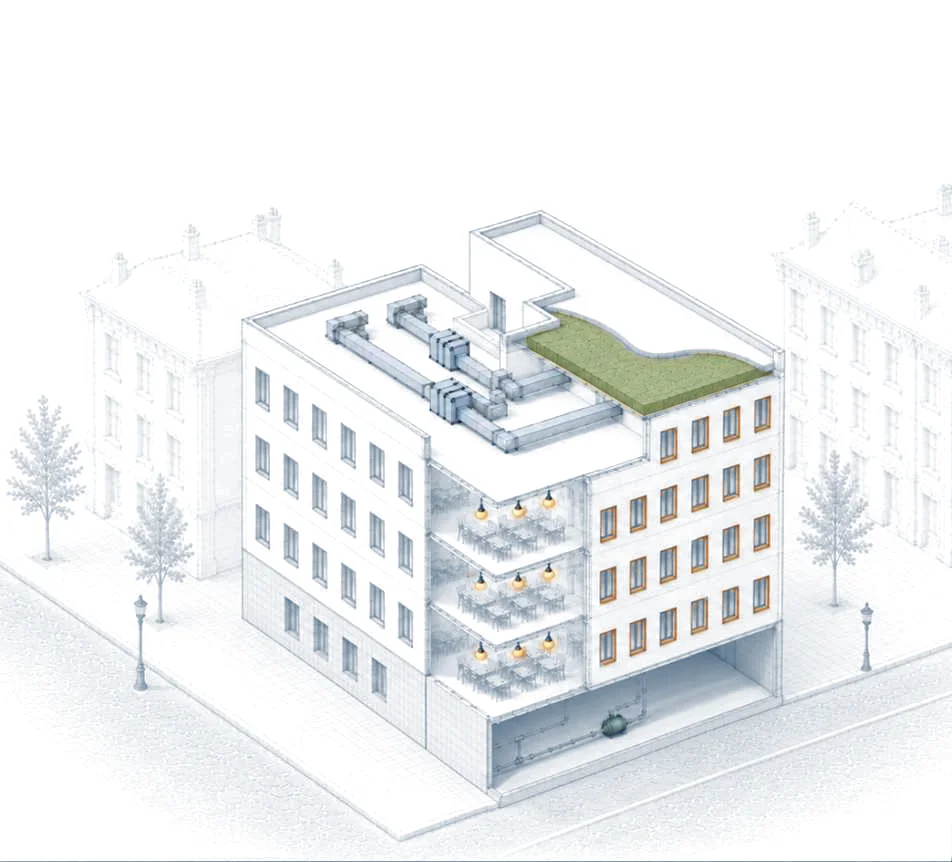
37 %
energy saving by AHU improvement
40 %
average ROI with converting from CAV to VAV system
3–6
years payback for the ventilation measures in both buildings
Awarded the Miljöfond scholarship of Sveriges Ingenjörer (the Swedish Association of Graduate Engineers) for its contribution to the sustainable development of the built environment.
Published at lup.lub.lu.se/student-papers/record/9230933
Context
The 2024 recast of the EU buildings directive introduces binding minimum standards for existing non-residential buildings. The worst-performing 16 % of the stock must reach a threshold by 2030, rising to 26 % by 2033; transposition into Swedish law is due by May 2026. This creates substantial renovation pressure in a short time.
The difficulty lies in the data: in existing buildings, simulated and measured consumption regularly diverge, and many inputs cannot be verified. The thesis therefore develops a procedure that does not eliminate this uncertainty but carries it explicitly.
Aim of the project
To develop a framework that accounts for model uncertainty and identifies cost- and energy-effective renovation pathways, with potential for scalability.
Overall workflow
Fitted energy model
Building models were calibrated using measured heating data and validated according to ASHRAE Guideline 14 criteria.
Uncertainty & parametric simulation
Three energy models were retained for each building to account for uncertainty. The most influential parameters affecting heating demand were identified and evaluated.
Techno-economic evaluation
Renovation packages were assessed based on energy savings, payback period, and return on investment across all retained models.
01
Case studies
Two district-heated Stockholm offices — one with near-absent, one with good heat recovery — span the realistic baseline range.
Building A
Building B
Function
Office (100 %)
Office (84 %) · Retail (16 %)
Year built · heated area
1890 · 1,360 m²
1898 · 3,088 m²
Ventilation
CAV · heat recovery 12 %
CAV · heat recovery 60–75 %
02
Model fitting
Three calibrated models per building keep the residual uncertainty visible instead of hiding it.
Sensitivity screening
Non-observable inputs went through a sensitivity screening: anything moving heating demand by more than 5 % became a fitting variable. Ventilation parameters ranked clearly first in both buildings.
Average effect on heating demand
Model fitting
All combinations of the governing parameters were simulated and scored against measured heating data under ASHRAE Guideline 14.
- CV(RMSE) ≤ 15 %
- NMBE within ±5 %
- Monthly filter in the heating season
Representative models
Rather than a single best fit, three energy models per building were retained as representative cases.
Building A
3 envelope variants
Building B
3 envelope & ventilation variants
03
Measures and packages
Six measures from ventilation, envelope and auxiliary systems — assessed individually and in every combination.
Ventilation
AHU replacement
CAV → VAV
Envelope
Roof insulation
Window replacement
Auxiliary
LED lighting
Pump replacement
Every on/off combination was simulated as a package — 64 packages for both buildings, for each fitted model.
- Each measure was analysed individually by energy savings and simple payback.
- All combinations were then assessed as packages to rank their profitability, prioritise measures and derive an investment-based renovation pathway for each building.
04
Results for individual measures
Ventilation dominates: replacing the AHU and converting CAV→VAV deliver by far the largest savings.
Annual energy saving in kWh/m²·a — averages across the three fitted models per building
- Ventilation measures deliver the highest savings.
- The ranking of measures is consistent across all fitted models.
- Variation in savings reflects baseline uncertainty.
05
Renovation pathway
The same three-step pathway holds in both buildings: ventilation and lighting first, envelope last.
ROI
LED lighting + AHU replacement
> 30 %
+ CAV → VAV
> 25 %
+ Roof insulation
≈ 20 %
+ Window replacement
≈ 10 %
Prepared as a basis for decisions by building owners and investors — conceptually comparable to Germany's individual renovation roadmap (iSFP).
ROI — return on investment: average annual cost saving relative to the invested cost
06
Key findings
The ranking is robust
The same renovation sequence emerges in both buildings, across all fitted models and baseline assumptions.
Uncertainty does not always affect the outcome
Savings shifted between the fitted models — the order of measures did not.
A path toward scalability
If impactful parameters can be reliably documented, this framework can scale.
Software
- Rhino
- Grasshopper/Honeybee
- EnergyPlus
- Revit
- Excel
MSc Energy-efficient and Environmental Building Design, Lund University · 2026